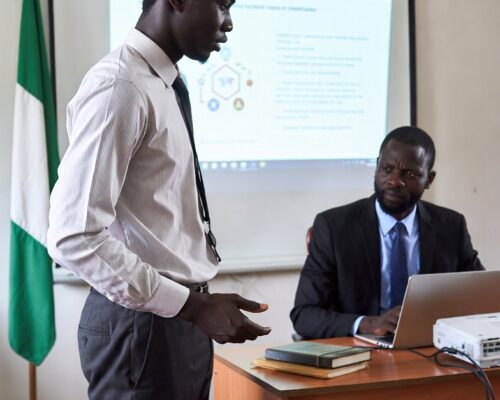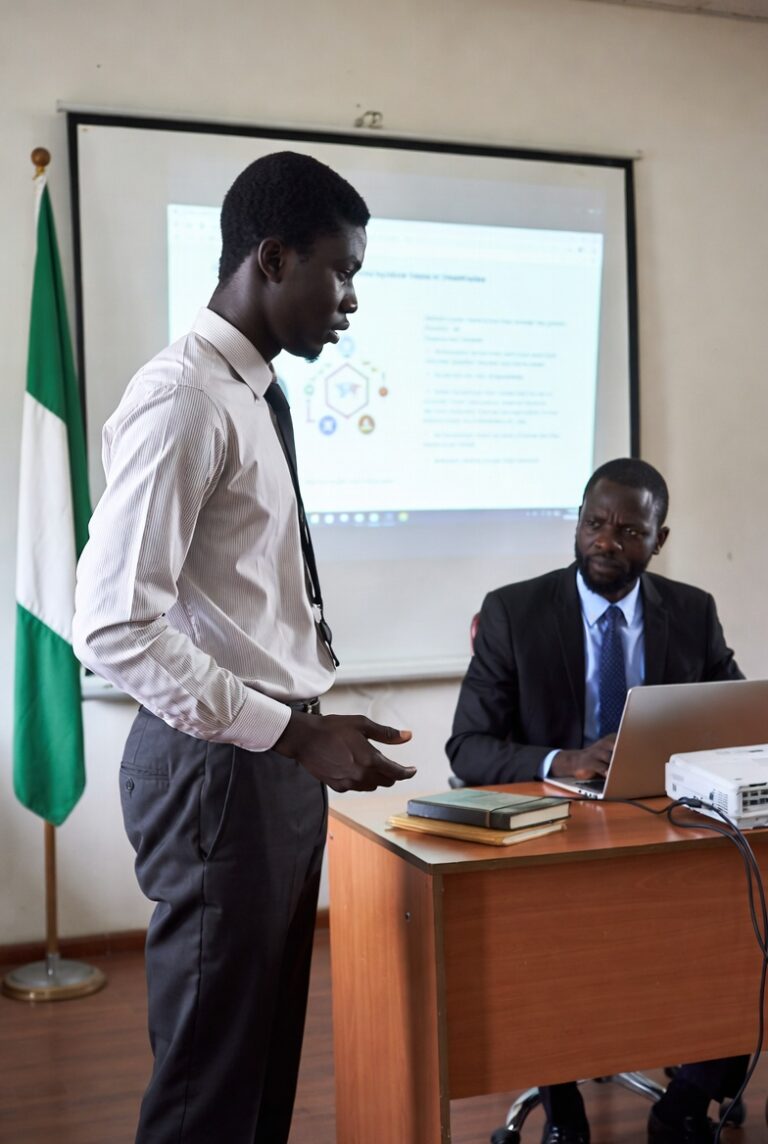
The project defense (viva voce) is often the most nerve-wracking part of final year for Nigerian university students—whether in UNIBEN, UI, UNILAG, or any other institution. Lecturers (internal and external examiners) love to probe your depth of understanding, originality, and ability to justify every choice you made. They ask tough questions to test if you truly own the work or just assembled it under pressure.
Here are **15 tough, frequently asked questions** Nigerian lecturers throw at students during defense, drawn from real experiences across departments (social sciences, engineering, education, sciences, business, etc.). I’ve included realistic, confident ways to answer them—tailored for the Nigerian context where panels can be strict, time-conscious, and sometimes unpredictable.
1. **In a nutshell, what is your project all about?**
*Why it’s tough*: It sounds easy, but many freeze or ramble.
*How to answer*: Start with a 30-60 second summary mirroring your abstract: “My project examines [core problem] in [specific context, e.g., Benin City markets or Nigerian banking sector], using [method] to achieve [main objectives]. The key finding is [one major result], which contributes to [practical/theoretical value].” Keep it crisp—don’t read your slides.
2. **What motivated you to choose this topic?**
*Why it’s tough*: Panels sniff out if it’s genuine or just “to graduate.”
*How to answer*: Tie it to real issues: “The motivation stems from the rising [issue, e.g., youth unemployment in Edo State] and gaps in existing studies on [specific angle]. As a final-year student witnessing [personal/local observation], I aimed to provide actionable insights for policymakers/NGOs.”
3. **Why is this problem worth researching in Nigeria today?**
*Why it’s tough*: They want relevance beyond academics.
*How to answer*: Link to national priorities: “This problem is critical because it affects [SDG/economic sector/Nigerian policy, e.g., financial inclusion under CBN guidelines]. Solving it could reduce [impact, e.g., poverty levels or operational inefficiencies] in our context.”
4. **What are the main limitations of your study?**
*Why it’s tough*: Admitting weaknesses feels risky.
*How to answer*: Be honest but frame positively: “Key limitations include the sample size restricted to [e.g., Benin City due to time/funds constraints] and reliance on self-reported data, which may introduce bias. However, these were mitigated through [e.g., triangulation/multiple sources], and future studies could expand to nationwide sampling.”
5. **How did you ensure the reliability and validity of your data?**
*Why it’s tough*: Methodology deep-dive—many trip here.
*How to answer*: Reference tools: “Reliability was ensured via Cronbach’s Alpha (score: X.XX) for the questionnaire. Validity through content validation by experts and pilot testing. For qualitative data, I used member checking and thick description.”
6. **Why did you choose this research design/methodology over others?**
*Why it’s tough*: They test if you understand alternatives.
*How to answer*: Justify fit: “A mixed-methods approach was ideal because the topic requires both quantitative trends [e.g., survey stats] and qualitative depth [e.g., interviews]. A purely quantitative design would miss contextual nuances in Nigerian settings.”
7. **How do your findings align with or differ from existing literature?**
*Why it’s tough*: Probes your lit review depth.
*How to answer*: Compare directly: “My findings align with [Author, year] on [point], but differ from [Another author] due to [e.g., Nigeria-specific factors like economic volatility or cultural influences], highlighting contextual variations.”
8. **What is the most significant contribution of your work?**
*Why it’s tough*: Avoid sounding boastful.
*How to answer*: Be specific: “This study contributes a new framework/model for [issue] in Nigerian contexts, fills a gap in empirical data from [region], and offers practical recommendations for [stakeholders, e.g., government or businesses].”
9. **If you had more time/money, what would you do differently?**
*Why it’s tough*: Reflects critical thinking.
*How to answer*: Show growth: “I would increase the sample size for broader generalizability, incorporate longitudinal data, or use advanced tools like [e.g., GIS for spatial analysis] to strengthen causal claims.”
10. **How would you replicate this study in another Nigerian state?**
*Why it’s tough*: Tests transferability.
*How to answer*: Adapt thoughtfully: “The methodology remains the same, but I’d adjust the sampling to reflect local demographics, account for regional differences [e.g., urban vs. rural dynamics in Lagos vs. Edo], and validate instruments culturally.”
11. **Explain one key concept/variable in your study and how you operationalized it.**
*Why it’s tough*: They pick obscure ones to test understanding.
*How to answer*: Be precise: “Customer satisfaction was operationalized using a 5-point Likert scale adapted from [source], measuring dimensions like reliability, responsiveness, etc., scored as mean values for analysis.”
12. **What ethical considerations did you address?**
*Why it’s tough*: Often overlooked in undergrad projects.
*How to answer*: Cover basics: “Informed consent was obtained, anonymity assured, participation voluntary. No vulnerable groups were involved, and data stored securely per university guidelines.”
13. **Your hypothesis was rejected/accepted—why do you think that happened?**
*Why it’s tough*: Statistical interpretation.
How to answer: Link back: “The null was rejected because p-value (0.XX) < 0.05, indicating significant relationship, likely due to [real-world factor, e.g., post-COVID shifts in behavior]. This supports theory X in our context.”
14. How does your recommendation solve the problem you identified?
Why it’s tough: Tests practicality.
How to answer: Make it actionable: “Recommendation 1 suggests [specific action, e.g., policy training programs], directly addressing the gap in [problem area] by building capacity among [target group], potentially reducing [impact] by X% based on findings.”
15. Any questions for the panel? (The curveball closer)
Why it’s tough: Rare but catches you off-guard.
How to answer: Show engagement: “Yes based on my findings, do you recommend expanding this to a multi-state study, or focusing on [related area] next?” Or politely: “No sir/ma, but I appreciate any further suggestions for improvement.”
Quick Naija Defense Survival Tips
– Greet politely (“Good afternoon, distinguished panel”), smile, stand straight.
– If stuck: “That’s an excellent question allow me a second to recall…” or “I didn’t explore that deeply, but logically…”
– Practice aloud with friends record yourself.
– Own your work: Say “In my study…” not “The project shows…”
– Thank them at the end—no matter how tough.
You’ve got this! Many have survived worse panels and graduated with flying colors. Stay calm, breathe, and remember: they want to see understanding, not perfection. Drop your department or topic in the comments if you want more tailored prep! 🚀